
When Do You Need to Register as a CIS Contractor?

Business is picking up. You have more work than you can handle on your own, so you bring in another trade to help. That is a good sign for your business, but it also brings a new set of responsibilities.
The moment you start paying subcontractors for construction work, you are a contractor under CIS. This guide explains when you need to register, what you have to do every month, and the penalties that catch new contractors out.
The short answer: before you pay your first subcontractor
HMRC says you must register as a CIS contractor when you are about to take on and pay your first subcontractor.
This applies whether that subcontractor will have tax deducted or will be paid in full with gross payment status. Registration is not optional for contractors.
Am I a contractor under CIS?
Under CIS, “contractor” has a much wider meaning than it does on site. You are a contractor if your business pays subcontractors for construction work. That includes:
- builders and main contractors
- trades who bring in other trades, for example a plasterer who pays a labourer or a roofer who subcontracts the leadwork
- property developers
- gang leaders who organise labour
- property investors whose work turns into development, such as converting a building to a new use
You can be a contractor and a subcontractor at the same time. A groundworker paid by a main contractor who also pays their own team has to follow the subcontractor rules on money coming in and the contractor rules on money going out.
Businesses outside construction
Some businesses that are not in construction are treated as contractors too. These are called deemed contractors. A business becomes a deemed contractor when its spending on construction work goes over £3 million in a 12 month period, and it has to keep an eye on that spend.
For most trades and construction businesses, this rule does not apply. You will be a mainstream contractor from your first subcontractor payment.
When you are not a contractor
- Private householders having work done on their own home are not contractors
- Employees are not covered by CIS. If the person working for you is genuinely employed, they must be paid through PAYE
That second point matters. Calling someone self-employed does not make them self-employed. Before you take anyone on, you have to consider whether they are really a subcontractor or an employee. On every monthly return you declare that you have done this.
How to register as a CIS contractor
You register through the same process as setting up as a new employer with HMRC. HMRC will then set up your contractor scheme, and a PAYE scheme too if you ask for one.
If you already run payroll, your CIS responsibilities will sit alongside it.
What you must do once you are registered
This is where most new contractors get caught out. Registering is the easy part. The monthly routine is what matters.
1. Verify every new subcontractor before you pay them
Before paying a subcontractor, check with HMRC that they are registered. HMRC will tell you whether to:
- pay them in full (gross payment status)
- deduct 20% (registered)
- deduct 30% (not registered, or cannot be verified)
You do not need to verify a subcontractor again if you included them on a return in the current tax year or the two before it.
To verify, you need the subcontractor’s legal name and UTR, plus their National Insurance number if they are a sole trader or company registration number if they are a limited company.
2. Deduct the right amount
Deductions are taken from the labour part of the payment only. Take off the cost of materials the subcontractor bought for the job, and VAT, before working out the deduction. Keep a record of the gross amount, the materials and the deduction for every payment.
Only the amount the subcontractor actually paid for materials is left out. If they have added a markup to the materials on their invoice, the markup is treated as labour and must have CIS deducted from it.
You can ask for evidence of materials costs, and you should. If the materials figure is overstated and too little tax is deducted, HMRC can come to you for the difference.
3. Give deduction statements
Every subcontractor you deduct tax from must receive a payment and deduction statement within 14 days of the end of each tax month. Tax months run from the 6th of one month to the 5th of the next, so the statement is due by the 19th. For example, payments made between 6 May and 5 June need a statement by 19 June.
4. File your monthly CIS return
Your return must reach HMRC by the 19th of every month, covering payments from the 6th of the previous month to the 5th of this one.
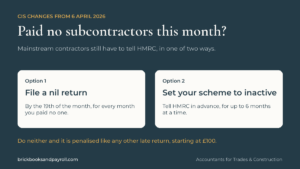
From 6 April 2026, nil returns are back. If you did not pay any subcontractors in a month, you must still file a nil return or tell HMRC your scheme is inactive. HMRC can make your scheme inactive for up to six months if you know you will not be paying subcontractors for a while.
5. Pay the deductions to HMRC
Pay the deductions by the 22nd of the month if you pay electronically, or the 19th otherwise. If your average monthly payments to HMRC, including any PAYE, are under £1,500, you may be able to pay quarterly instead. Returns must still be filed monthly.
If you forget to make a deduction, you still owe it. HMRC expects the contractor to pay what should have been deducted.
6. Keep your records
Keep CIS records for at least three years after the end of the tax year they relate to.
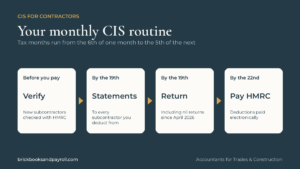
CIS contractor key dates at a glance
| Task | Deadline |
| Verify a new subcontractor | Before you pay them |
| Payment and deduction statements | 19th of the month |
| Monthly CIS return, including nil returns | 19th of the month |
| Pay deductions electronically | 22nd of the month |
| Keep records | At least 3 years |
The penalties for late CIS returns
CIS penalties are automatic, and they apply to each late return, not just once:
- £100 the day after the deadline
- £200 more if still outstanding two months later
- the greater of £300 or 5% of the deductions due six months after the deadline
- the greater of £300 or 5% again at twelve months, and more if HMRC believes information was deliberately withheld
Miss a few months and the penalties quickly run into thousands of pounds.
There is a second risk too. If you are also a subcontractor with gross payment status, failing to run CIS properly as a contractor can cost you that status, and your own cash flow with it.
Frequently asked questions
Do I need to register as a contractor if I only use one subcontractor?
Yes. One subcontractor is enough. You must register before you pay them.
Do I need to file a return if I did not pay anyone this month?
Yes, from 6 April 2026 mainstream contractors must file a nil return or tell HMRC their scheme is inactive. Otherwise a penalty will be issued.
What if my subcontractor has gross payment status?
You still need to be registered, still need to verify them, and still need to include their payments on your monthly return. You just do not deduct any tax.
Can I pay a subcontractor before I have verified them?
Only if you have included them on a return in the current or previous two tax years. Otherwise you must verify first.
What if I get a return wrong?
Errors can be corrected by amending the return. HMRC usually only charges penalties for incorrect returns where it believes the mistake was careless or deliberate.
Take CIS off your to-do list
Running CIS as a contractor means verifying, calculating, issuing statements, filing and paying on time, every single month. Miss one step and the penalties start straight away. Brickbooks and Payroll works exclusively with trades and construction businesses. Our team handles CIS every month, so you can get on with running your jobs.
Get your instant price in under a minute and see what it costs to have your monthly CIS handled for you.
Related reading: What is CIS? | When to register as a CIS subcontractor
This article is general guidance based on HMRC’s published CIS guidance at the time of writing. Your own position may differ, so speak to an accountant before acting on it.