
When Should You Register as a CIS Subcontractor?
You have left your job, got your tools and van sorted, and a contractor has offered you work. One of the first questions they will ask is whether you are CIS registered.
If the answer is no, you will lose more of every payment than you need to. This guide explains when to register as a CIS subcontractor, how to do it, and what happens if you leave it too late.
The short answer: before you start work
HMRC’s guidance is clear. You should register as a CIS subcontractor when you are about to start work in the construction industry.
That means before your first job for a contractor, not after your first payment, and not when you get round to your tax return.
Registration itself is free. Leaving it costs money.
What happens if you do not register?
Registering as a subcontractor is not compulsory. But if a contractor cannot verify you with HMRC, they must deduct tax at the higher rate.
| Your CIS status | Deduction from your labour |
| Registered | 20% |
| Not registered | 30% |
That extra 10% is taken from every payment until you register.
What that extra 10% really costs
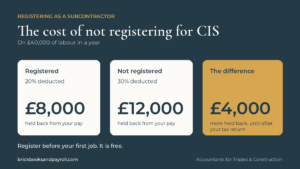
Say you earn £40,000 of labour in a year:
- registered at 20%: £8,000 deducted
- not registered at 30%: £12,000 deducted
That is £4,000 more held back from your pay across the year.
Deductions are counted towards your tax bill, so you may get some of it back after your tax return. But you could be waiting well over a year for money you needed to pay for fuel, materials and the mortgage. For most subcontractors, that cash flow hit hurts far more than the tax itself.
Do I need to register if I am a limited company?
Yes, the same rules apply. A limited company that carries out construction work for contractors should register as a CIS subcontractor, otherwise contractors will deduct at 30%.
The company needs to be set up first. Once it has its Corporation Tax Unique Taxpayer Reference (UTR), it can register for CIS.
Do I need to register if I only work for homeowners?
Private householders are not contractors under CIS, so no deductions are taken on work done directly for them.
If you only ever work for homeowners, CIS may not affect you. But the moment you take a job from a builder, developer or main contractor, it does. Most trades end up working for contractors sooner or later, so registering early avoids a rushed job later.
How to register as a CIS subcontractor
How you register depends on where you are starting from.
If you are new to self-employment and do not have a UTR yet
Register as a new business for Self Assessment. When asked, choose that you are working as a subcontractor. HMRC will register you for Self Assessment and CIS at the same time.
If you are a sole trader and already have a UTR
You can register for CIS online using your Government Gateway user ID. If you do not have one, you can create it as part of the process.
If you are a limited company
Register the company first, then register it as a CIS subcontractor once it has its UTR.
You can also apply for gross payment status at the same time as registering, if you already meet the conditions.
What you need to give your contractor
Once you are registered, contractors will need your details before they pay you so they can verify you with HMRC. Have these ready:
Sole trader
- your legal name as registered with HMRC
- your UTR
- your National Insurance number
Limited company
- the company’s name
- the company’s UTR
- the company registration number
Use your legal name, not your trading name. If you give a contractor “Smith Plastering” but HMRC has you registered as John Smith, the contractor may not be able to verify you. They will then have to deduct at 30%, even though you are registered.
Remember your tax return deadline too
Registering for CIS is not the only deadline when you start out. If you are new to self-employment, you must also tell HMRC by 5 October after the end of the tax year you started working for yourself. Registering through Self Assessment, as above, covers both.
Once you are up and running, keep every payment and deduction statement your contractors give you. You will need them to claim your CIS deductions on your tax return.
Should I apply for gross payment status straight away?
Gross payment status means contractors pay you in full, with no deductions. To qualify, HMRC looks at three things:
- Business test: you do construction work in the UK and run the business through a bank account
- Turnover test: for a sole trader, at least £30,000 of construction turnover in the previous 12 months, not counting VAT or materials. Partnerships and companies have different thresholds
- Compliance test: your tax returns and payments have been on time
Most people starting out will not meet the turnover test straight away. That is fine. Register at 20% now, keep your tax affairs up to date, and apply for gross payment status once you qualify.
Frequently asked questions
How long does CIS registration take?
HMRC will write to confirm your registration. Register before you start work so it is in place when your first contractor verifies you.
Can I register for CIS after I have started working?
Yes, but any payments made before a contractor can verify you will be deducted at 30%. The sooner you register, the sooner you move to 20%.
Does it cost anything to register for CIS?
No. Registering with HMRC is free.
Will I get the extra deductions back?
Deductions count towards your tax and National Insurance for the year, and any overpayment is refunded after your tax return. But you wait for that money, and only if your return is done correctly.
What if I am both a subcontractor and I pay other trades?
Then you are also a contractor under CIS and need to register as one. Read our guide on when to register as a CIS contractor.
Start out on the right footing
Getting CIS set up properly at the start saves you money on every invoice and a lot of stress at tax return time. Brickbooks and Payroll works exclusively with trades and construction businesses. Our team can get you registered, make sure your contractors have the right details, and claim back every deduction you are owed.
Get your instant price in under a minute and see what it costs to have your CIS and tax return taken care of.
Related reading: What is CIS? | When to register as a CIS contractor
This article is general guidance based on HMRC’s published CIS guidance at the time of writing. Your own position may differ, so speak to an accountant before acting on it.