
How do you work out holiday pay for irregular hours and changing shifts?

How do you work out holiday pay for irregular hours and changing shifts?
Written by the Brickbooks and Payroll team. Reviewed by a MAAT qualified accountant. Last reviewed: November 2026.
If you employ cleaners for builders cleans, labourers or other staff whose hours go up and down, holiday questions come up often in payroll. Some staff work set days, some work whenever they are needed, and some swap shifts or change contracts all the time. This guide explains how holiday pay for irregular hours, and the other methods, are worked out and recorded in payroll. The government and Acas sources are listed at the end.
Holiday pay for irregular hours: the short answer
- Almost every worker gets 5.6 weeks of paid holiday a year, capped at 28 days.
- Set days and hours: give each person a yearly entitlement, worked out pro rata (in proportion to the days they work).
- Irregular hours or part of the year only: for leave years starting on or after 1 April 2024, holiday builds up at 12.07% of the hours worked in each pay period.
- Rolled-up holiday pay: for those irregular and part-year workers only, you can choose to add 12.07% of their pay to every payslip instead, shown as a separate line.
A worked example
These figures are made up to show how the sums work.
You employ two cleaners who do builders cleans.
- Cleaner A works 3 set days every week, all year. Her holiday is 3 days × 5.6 weeks, which is 16.8 days a year.
- Cleaner B works whenever jobs come in, so she needs holiday pay for irregular hours. In one month she works 68 hours. Her holiday builds up at 12.07% of 68 hours, which is 8.2 hours. That rounds to 8 hours of holiday.
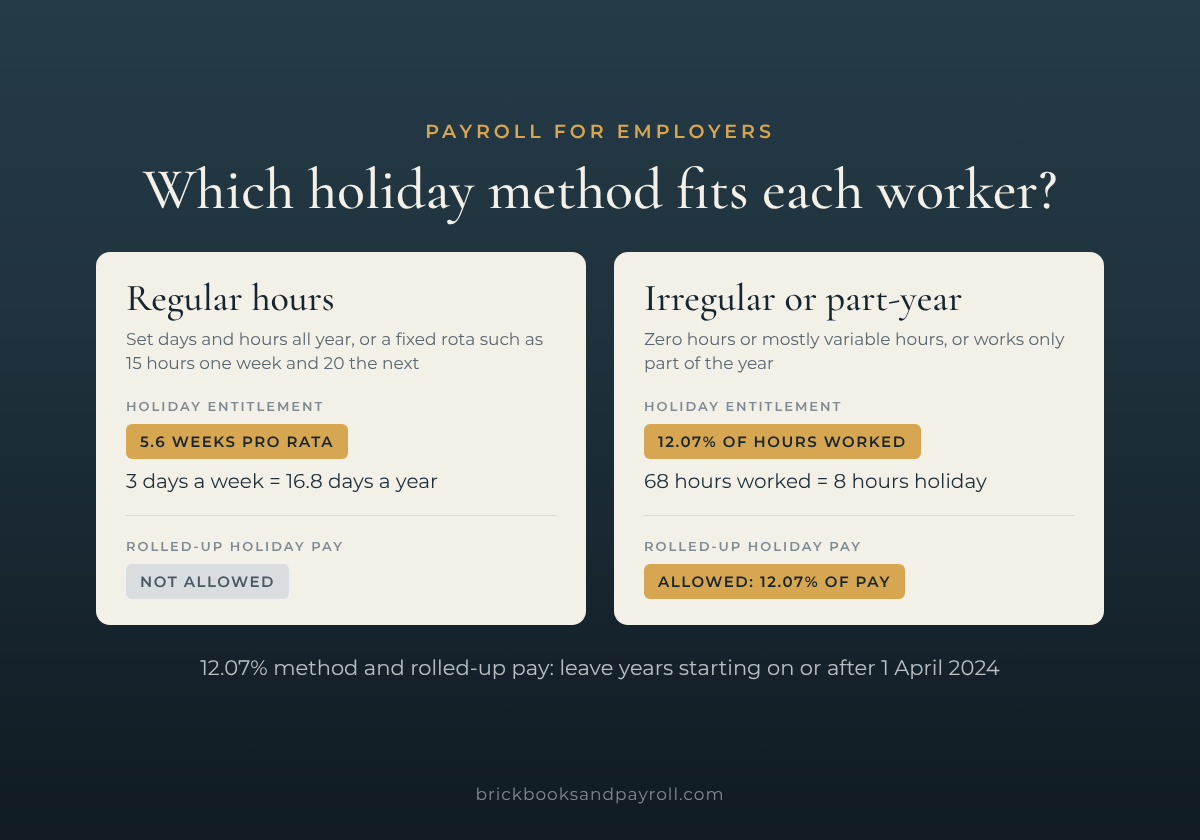
If you use rolled-up holiday pay for Cleaner B instead, and she earns £850 that month, her payslip shows an extra £102.60 (12.07% of £850) as holiday pay, on its own line.
Step 1: work out which type of worker each person is
Before you work out holiday pay for irregular hours, check who actually has irregular hours. The method depends on the type of worker, not their job title. The government’s guidance on holiday pay and entitlement reforms from 1 January 2024 sets out the types:
- Regular hours. Their contract sets their days and hours. This includes a fixed rota, such as 15 hours one week and 20 the next, because the hours are still set.
- Irregular hours. Under their contract, the hours they are paid for in each pay period are wholly or mostly variable. Zero hours and casual contracts can fall into this group.
- Part-year. They only work part of the year, and there is at least one week in their contract when they are neither working nor paid.
A business can have all three types at once, so it helps to write the type next to each name on your payroll list.
Method 1: staff on set days and hours
For regular-hours staff, the entitlement is 5.6 weeks a year, pro rata.
- Full time. Someone working 5 days a week gets at least 28 days.
- Part time. Someone working 3 days a week gets at least 16.8 days.
- Bank holidays. You do not have to give bank holidays as paid leave, but you can count them as part of the 5.6 weeks.
- First year. Holiday can build up at one-twelfth of the year’s entitlement each month.
You also need a leave year (for example, 1 January to 31 December) and to tell staff what it is when they start. The government page on how to calculate leave entitlement has the full rules and a calculator.
Method 2: holiday pay for irregular hours (the 12.07% method)
For irregular-hours and part-year workers, for leave years starting on or after 1 April 2024, holiday builds up from the hours actually worked. This is the standard method of holiday pay for irregular hours.
- Add up. Take the hours worked in the pay period.
- Multiply by 12.07 and divide by 100.
- Under half an hour rounds down. Half an hour or more rounds up.
- Add the result to their holiday balance. They can use it from the next pay period.
The 12.07% comes from 5.6 weeks of holiday set against the 46.4 weeks a year a person is working. The total is still capped at 28 days.
When the worker takes the holiday, holiday pay for irregular hours is usually their average weekly pay over the last 52 weeks in which they were paid. Weeks with no pay, or with only statutory sick pay or reduced statutory pay (such as maternity pay), are skipped. You can look back up to 104 weeks to find 52 weeks of usual pay. See the government page on holiday pay.
Method 3: rolled-up holiday pay for irregular hours
Rolled-up holiday pay means paying the holiday as you go, instead of when the holiday is taken. It is the second way to handle holiday pay for irregular hours.
- Only irregular-hours and part-year workers, and only for leave years starting on or after 1 April 2024. You cannot use it for regular-hours staff.
- How much. At least 12.07% of the worker’s total pay for the pay period.
- It must be paid with their pay for the work done and shown as a separate item on every payslip.
- Tell workers before you start. If it means changing their contracts, that is an employment law matter, and Acas explains the steps.
- Time off. The worker still takes time off. That holiday has already been paid, so no extra holiday pay is due when they take it.
- Taking holiday. You still need to make sure workers can take the holiday they are entitled to, and encourage them to take it.
It is optional. Workers on rolled-up pay must not lose holiday pay when they are off sick or on statutory leave, such as maternity leave. Their pay for those periods is based on their average holiday pay, usually over the previous 52 weeks. Acas explains this in its guide to rolled-up holiday pay.
Method 4: shifts swapped and contracts that keep changing
Swapped shifts and contract changes affect holiday in different ways:
- Swapped shifts. If a regular-hours worker swaps a shift but their contracted hours stay the same, their entitlement is still based on those contracted hours.
- New contracted hours. For regular-hours staff, entitlement is worked out in proportion to their contracted hours, so a change in contracted hours changes the entitlement from that point.
- A change of type. Holiday pay for irregular hours only applies while the contract makes someone an irregular-hours worker. The type of worker depends on what the contract says about their hours. The government guidance does not set out a method for a worker who moves from irregular to regular hours (or back) partway through a leave year.
Steps that help:
- Date it. Record the date of every contract change.
- Split it. Work out holiday for each part of the year under the contract that applied at the time.
- Check it. Make sure your payroll software has the right worker type and method for each person after every change.
Records, carry over and staff who leave
- From 6 April 2026, employers must keep records of annual leave and holiday pay, including holiday carried over, for at least six years. That includes holiday pay for irregular hours.
- Carry over. Statutory holiday should normally be taken in the leave year. A contract or other agreement can allow some to be carried over. Different rules apply where someone could not take holiday because of long-term sickness or statutory leave, or was not given the chance to take it.
- When someone leaves, you pay for statutory holiday they have built up but not taken.
The records rule is explained in Acas’s guide to holiday for irregular hours and part-year workers, and the carry over rules in its guide to carrying over holiday. The guide to payroll compliance covers the other payroll records you need to keep.
Dates to know
- 1 April 2024: leave years starting on or after this date use the 12.07% method and can use rolled-up pay for irregular-hours and part-year workers.
- 6 April 2026: records of annual leave and holiday pay must be kept for at least six years.
- Start of each leave year: check every worker’s type and method.
- Every contract change: record the date and recheck the method.
Holiday pay for irregular hours: a quick checklist
- Have you written down whether each person is regular hours, irregular hours or part-year?
- Do your staff know your leave year?
- For irregular and part-year staff, are you building up holiday at 12.07% of hours worked, or paying rolled-up holiday pay?
- If you use rolled-up holiday pay, is it on its own line on every payslip?
- Do you record the date of every contract change and recheck the method?
- Are you keeping at least six years of annual leave and holiday pay records?
Before you act
This guide is general information based on government and Acas guidance as at November 2026. It covers how holiday is worked out and recorded in payroll. It is not HR or employment law advice. The Brickbooks and Payroll team are accountants for trades and construction, not HR advisers or employment lawyers. Holiday pay for irregular hours depends on what each contract says and on your own circumstances. For questions about contracts, changing terms or a disagreement with a worker, Acas gives free advice, including its guide to holiday for irregular hours and part-year workers. You can also check the pages below or speak to your accountant before you act.
Brickbooks and Payroll Ltd, company number 14528647, licensed and regulated by the AAT, registered Authorised Corporate Service Provider (ACSP) with Companies House.
Sources
- Holiday entitlement: entitlement (gov.uk)
- Holiday entitlement: calculate leave entitlement (gov.uk)
- Holiday entitlement: holiday pay (gov.uk)
- Holiday pay and entitlement reforms from 1 January 2024 (gov.uk)
- Calculate holiday entitlement (gov.uk)
- Irregular hours and part-year workers: building up holiday (Acas)
- Irregular hours and part-year workers: rolled-up holiday pay (Acas)
- Irregular hours and part-year workers: holiday pay (Acas)